
Tempers were high as the two men came at each other with drawn guns. A feud had been smouldering between the two for some time, and the climax came when they met in a local bar and fired at each other-one with a .32-calibre revolver, the other with a .41-calibre Colt revolver.
Four shots were fired in all.
This scene might have taken place in the days of Wyatt Earp, with the participants staging an old-fashioned western shoot-out; actually, it took place in Cleveland, Ohio, in July, 1965.
When the smoke of battle had cleared, one of the participants had been hit twice-in the abdomen and in the arm-one of the shots had gone wild, and the fourth was unaccounted for.
Examination of the guns by Cleveland police revealed that the .41-calibre revolver was loaded with one .38 Colt NP cartridge and three .38 Special cartridges.
Police had difficulty in extracting one of the .38 specials from the chamber slot aligned with the barrel of the .41-calibre Colt revolver.
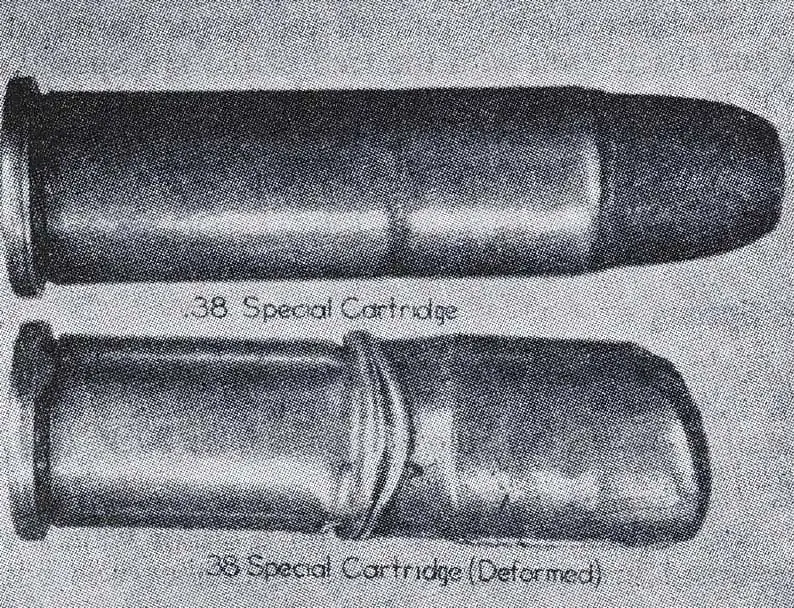
The case wall on this last cartridge had an accordion type fold about five-eighths inch from the head. A deformed cylindrical-shaped mass-the diameter of a .41- calibre-made up the bullet.
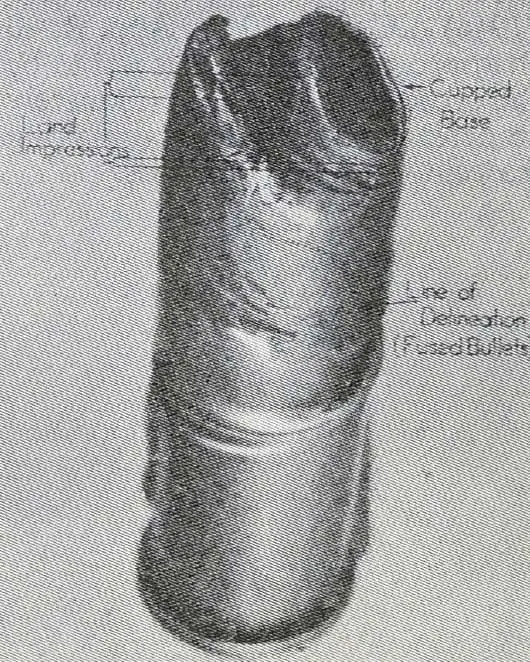
The overall length of the cartridge was 1.39 inches as compared with the 1.54-inch length of a standard .38 Special cartridge. Microscopic examination in the Cleveland Ballistics Laboratory disclosed that the deformed lead jammed in the chamber consisted of two fused bullets, with the cupped base of one constituting a portion of what would normally be the bullet nose.
Along the side of this cupped base, there is evidence of rifling with characteristics similar to those on the test shot fired from the .32-calibre Colt revolver. There were other markings on this bullet that could have been impressed on it by the barrel of the .41-calibre Colt revolver from which the deformed lead was removed.
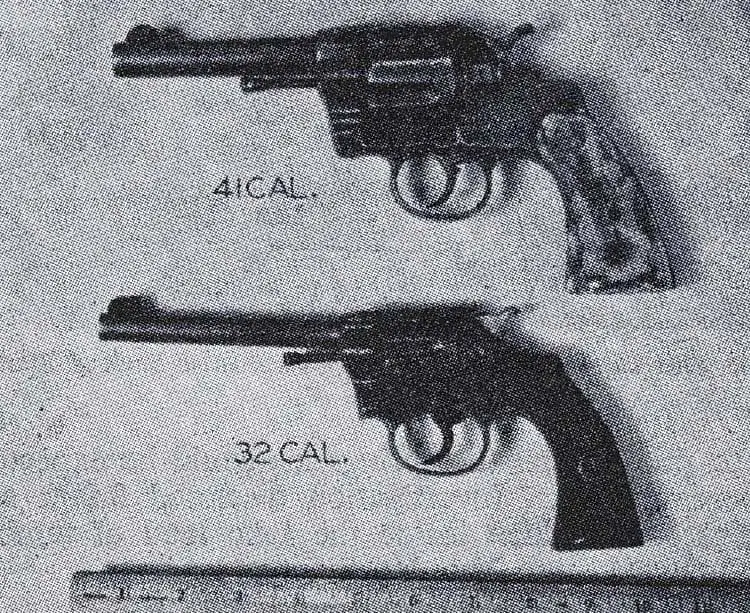
All evidence points to a one-in-a-million possibility, according to the Cleveland police. They surmise a shot fired from the .32-calibre revolver directly entered the larger barrel of the .41 revolver and fused itself with the lead of the .38 Special cartridge which was in the chamber aligned with the barrel. The force of the impact caused the cartridge case wall to fold, thus accounting for the shortening of the overall cartridge length.

