
|
Getting your Trinity Audio player ready...
|
INTRODUCTION
Eighty years is a huge milestone for any organisation, let alone a humble publication such as the APJ. When Simon Bouda asked me to prepare something to mark the anniversary, I was initially stumped as to the best way to begin.
While flicking through multiple copies of the APJ from across the decades, I decided a fitting tribute would be to not only give a brief overview of the development of the publication but also illustrate this history by highlighting one article from each decade which I find to be as interesting and informative now, as when it was written.
I emphasise that what follows is not a list of the ‘best’ eight articles. They are instead illustrative of the wide range of the more engaging, fascinating, sombre or just bizarre pieces that have appeared in the APJ, and hint at the evolution of policing in one lifetime.
I’ve also provided ‘honourable mentions’ because I found it impossible to meet my self-imposed target of only one article per decade.
All the articles are available in the subscribers’ section of the webpage.
THE FIRST DECADE: 1946 – 1955
In an era when recruit training courses lasted a handful of weeks and in-service training programs were rudimentary, when interstate travel was a rarity and few people had telephones, the APJ attempted to fulfil the role of a quasi-training manual and information guide. Content was sourced from each Australian force as well as reprinted from British and American publications.
Many aspects of policing – especially involving forensics/scientific investigations – were developing and cutting-edge innovations were shared in articles. Significant court decisions were also reported on in detail, to inform police of evolving interpretations of legislation. Serious crime case studies were periodically published, along with discussion pieces on a wide variety of topics including traffic policing, community engagement and training. To subsidise the cost of publication, multiple advertisements were included, selling items including alcoholic and non-alcoholic drinks, cigarettes, petrol/oil products and consumer goods.
Highlighted article
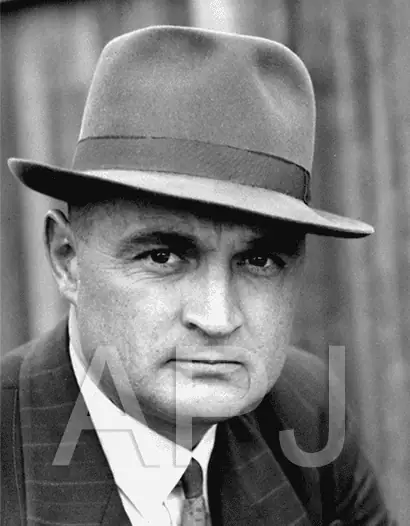
‘The Concrete Slab Murder: The Value of Circumstantial Evidence, by Detective Sergeant George Richards, October-December 1947.
A well-written homicide crime case highlighting how Western Australia police solved the murder of a woman whose body was found floating in the Swan River in December 1946. Justice moved much more swiftly back then; the offender was found guilty at trial in April 1947 and sentenced to hang soon afterwards. Just after the article was published the author left the police to join the Australian Security Intelligence Organisation where he subsequently became a deputy director-general. The article can be read HERE.
Honourable mention
‘Our Guests – The People’, by Constable T Boyle, September 1946.
This article in the first issue records the “kaleidoscopic procession” of people who present themselves at the front counters of police stations. Eighty years later, little has changed. The article was reprinted in the 75th anniversary issue in September 2021. The article can be read HERE.
THE SECOND DECADE: 1956 – 1965
The problems of policing juvenile delinquency were the theme of multiple articles throughout the decade and beyond. The prominence of scientific (technical) articles increased in frequency; some touched on extremely graphic topics not fit for general publication (hence the APJ’s ‘For Police Use Only’ classification of the era). Advertisements in the journal continued for items as diverse as cameras, film, legal books, typewriters and interstate train travel. Cigarette advertisements continued to be common, along with testimonials for a compound analgesic called Bex, which was later banned in Australia because it was highly addictive and caused kidney disease and cancer.
Highlighted article
‘Scientific Aspects of the Thorne Kidnapping and Murder in July, 1960’, by Detective Sergeant A. F. Clarke, July 1962.
The kidnapping and tragic murder of a child by a man desperate to take prize monies won by the parents in a lottery. This is the signature case study for the APJ in its early decades; a thorough account of the forensic case built against the murderer. It set the standard for subsequent crime case authors. The article can be read HERE.
Honourable mention
‘Thallium Poisoning in N.S.Wales’ [sic], by Superintendent J. H. Rogers, April 1957.
A fascinating insight into two women who used the poison thallium to murder numerous victims. The article has formed the basis of several subsequent documentaries about the actions of the offenders. The article can be read HERE.
THE THIRD DECADE: 1966 – 1975
Contrary to conventional pop-culture of the era, most senior police leaders of the time were well attuned to the need for policing attitudes and methodologies to evolve. In addition to the usual story mix, the APJ increased the frequency of articles on management, administration and the role of police in the community. It regularly published prize-winning essays from annual UK competitions on the future of policing. Many of the articles proved prescient to subsequent police reforms. The frequency of articles relating to illicit drugs and emergency management rose during this period.
Highlighted article
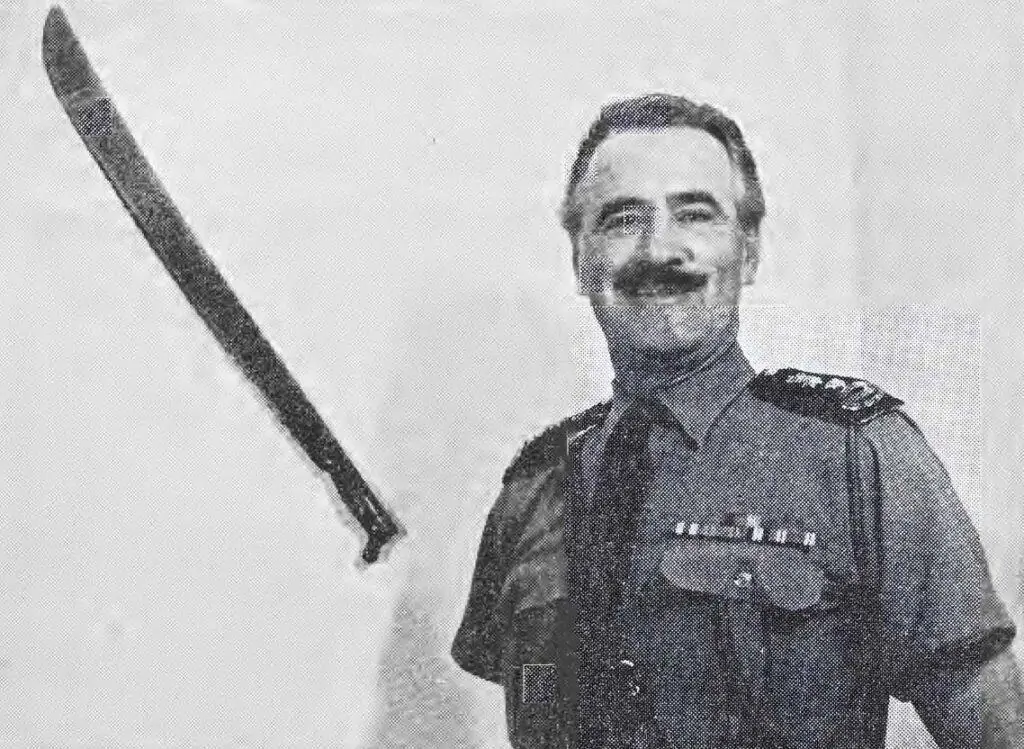
‘Cargo Cult/The Black Rooster: A true account of human sacrifice’, by Superintendent H. S. Thomas, January 1972.
Australia once had international mandates to administer some Pacific islands including what is now Papua New Guinea. This article, by an Australian police officer in the Royal Papua and New Guinea Constabulary, outlines the ‘cargo cult’ phenomenon in the Pacific, when local tribes had modernity thrust upon them. The article can be read HERE.
Honourable mention
‘Testifying in Court’, by unknown, January 1968.
This short article should be read by all new police. Even though some of the phrases and views expressed in the article are of their time, the underlying principles and tips on giving evidence are as crucial to professional policing today as in 1968. The article can be read HERE.
THE FOURTH DECADE: 1976 – 1985
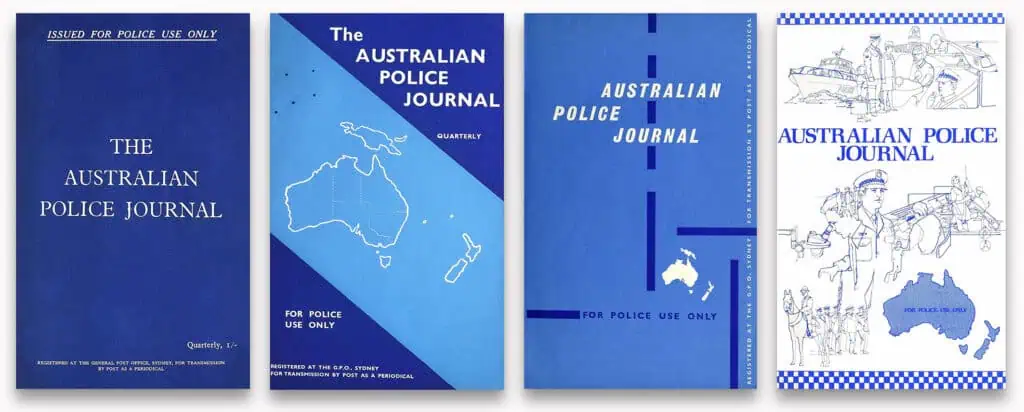
Under the stewardship of newly appointed editor Phil Peters, the appearance (and physical size) of the APJ changed in 1983 with the introduction of an A4-sized publication with coloured covers. Previous magazines had been in an A6 format with generic covers and few photographs, reflecting the limited printing technology of the era. The new layout was accompanied by regular columns such as Letters to the Editor. A change in censorship laws removed the restricted classification. The frequency of paid advertising reduced as the decade progressed, as did the regular publishing of court decisions.
With contributors such as the legendary Barry Fay coming on board, some issues were filled with just one or two crime case articles. Also, the focus of international policing articles changed. Previously, these articles had been sourced from overseas publications or contributors but with international air travel becoming cheaper, more articles were submitted from Australian police who had travelled overseas and wanted to share their observations of foreign law enforcement. The growing development of managerialism within policing saw an increase in the number of articles focused on administration, leadership and community engagement through new initiatives such as Neighbourhood Watch.
Highlighted article
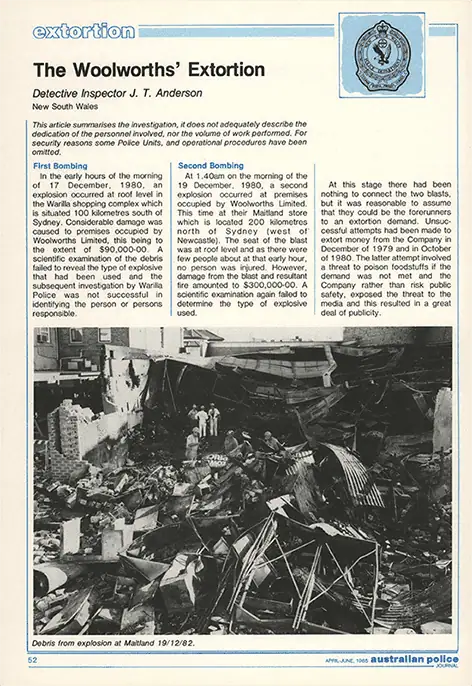
‘The Woolworths’ Extortion’, by Detective Inspector J. T. Anderson, April-June 1985.
The bombing of two Woolworths supermarkets was followed by a letter demanding $1 million to prevent further attacks, yet the extortionists attacked a third store. Fear gripped the state and police launched a massive investigation. The APJ is renowned for its homicide case studies but this is a great example of police tackling other types of violent and potentially deadly crimes. The article can be read HERE.
Honourable mention
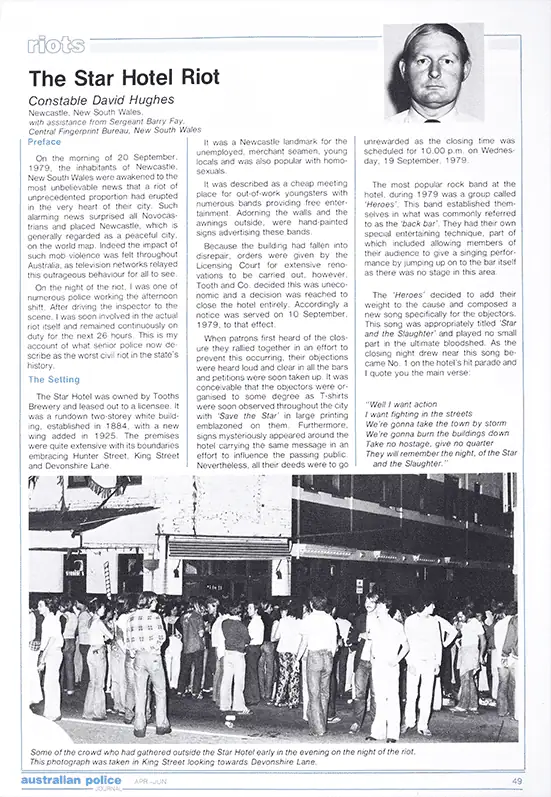
‘The Star Hotel Riot’, by Constable David Hughes, April-June 1983.
In 1979 a major riot broke out in Newcastle when police attempted to disperse a drunken crowd who were marking the final night of trading for a local pub. A police car was overturned and set alight, rioters were doused by fire hoses, scores were injured and/or arrested. After reading what occurred, I scratched my head wondering how the situation escalated so out of control. It was a different time. The article can be read HERE.
THE FIFTH DECADE: 1986 – 1995
Reflecting technological changes for policing during the decade, there were numerous articles on new equipment and how police work would be improved by computers and developments in forensics (e.g., DNA analysis). There was also a marked increase in the number of articles regarding extremely violent crimes such as explosives attacks, gruesome homicides and terrorism. Police professionalisation topics continued to feature throughout the era, including how tertiary studies could better prepare police for their duties. With the establishment of National Police Remembrance Day in 1989, the APJ began to regularly publish articles on the event as well as mark on-duty deaths. The frequency of poetry written by subscribers peaked during this era.
Highlighted article
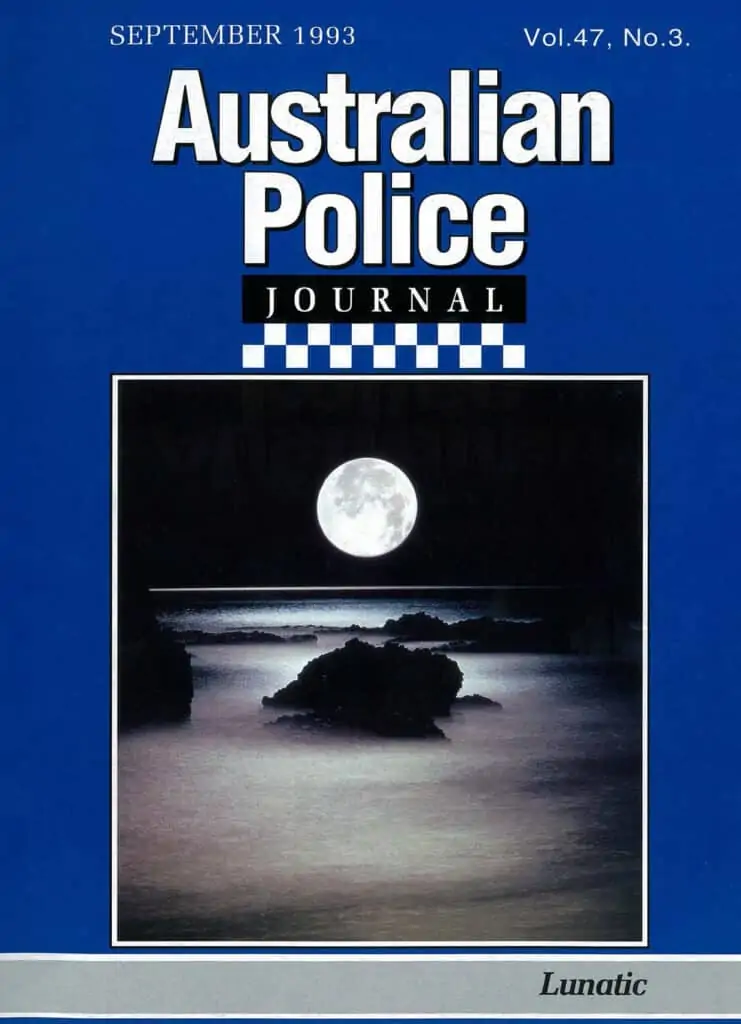
‘Lunatic’, by Barry Fay, September 1993.
Instead of a single article, this is an entire issue—the most sought-after issue of the APJ. Numerous case studies of suspicious suicides dominate ‘Lunatic’, providing what then Editor Phil Peters described as a page-turner with “lessons galore, particularly for young police”. The issue can be read HERE. Fascinating, but definitely not for the faint-hearted.
Honourable mention
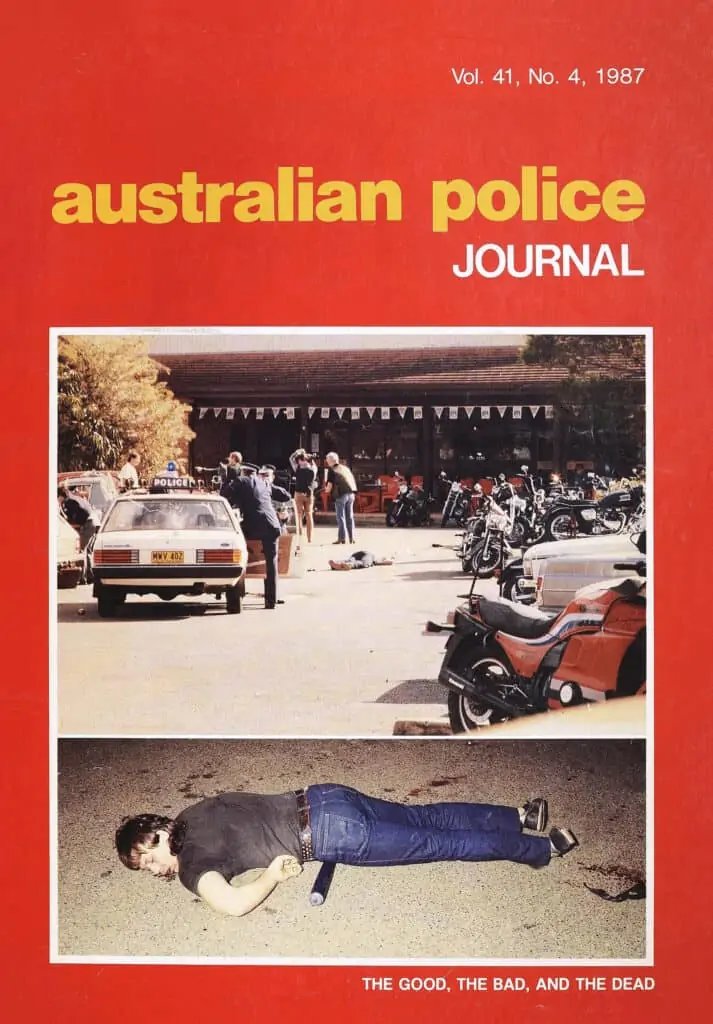
‘Milperra Bikie Massacre (Parts 1 and 2)’, by Detective Superintendent Ron H. Stephenson, October-December 1987 and July-September 1988.
This is the authoritative account of the police investigation into the Milperra Bikie Massacre, written by the senior detective who commanded the investigation. Seven people were murdered; 43 were arrested and charged. Part 1 focuses on the massacre and initial police investigation; Part 2 centres on the court cases. The 1987 issue can be read HERE; the 1988 issue can be read HERE.
THE SIXTH DECADE: 1996 – 2005
The most significant organisational change for the APJ since its establishment, occurred in 2000 when it became a not-for-profit company. The physical appearance of the magazine changed five times in a 14-year period, each change representing an effort to modernise its appearance. Significant policing events of the era such as the 2000 Sydney Olympics, the ‘9/11’ terrorist attacks and Australian police operations overseas were featured alongside the regular mix of educational, crime case and historical articles.
The focus of international policing articles began to shift from centring on how overseas police undertake their duties, to the offshore role and successes of Australian police. Annual awards for the best crime and educational articles were also introduced and continue to be awarded.
Highlighted article
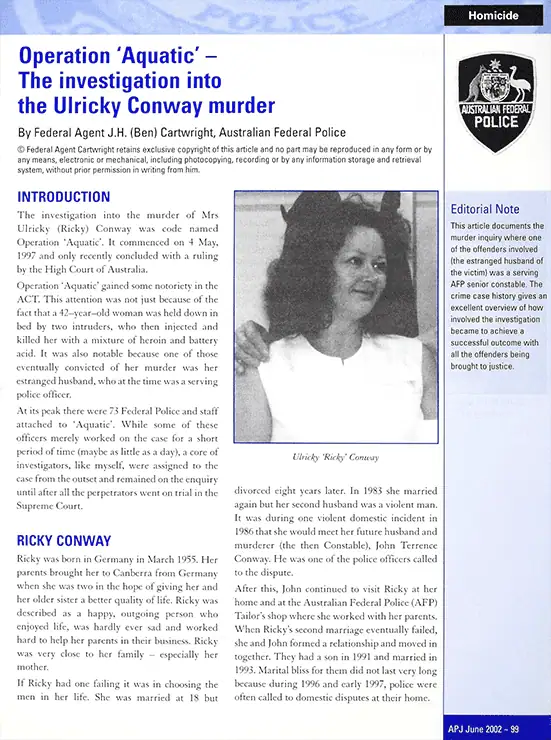
‘Operation ‘Aquatic’ – The Investigation into the Ulricky Conway Murder’, by Federal Agent J.H. (Ben) Cartwright, June 2002.
A truly vicious crime in which the victim was restrained and deliberately injected with a fatal dose of heroin and battery acid. It’s a unique case study for the APJ in that it’s the first article in which the criminal mastermind was a serving police officer (the victim’s estranged husband). A fascinating, page-turning read which can be read HERE.
Honourable mention
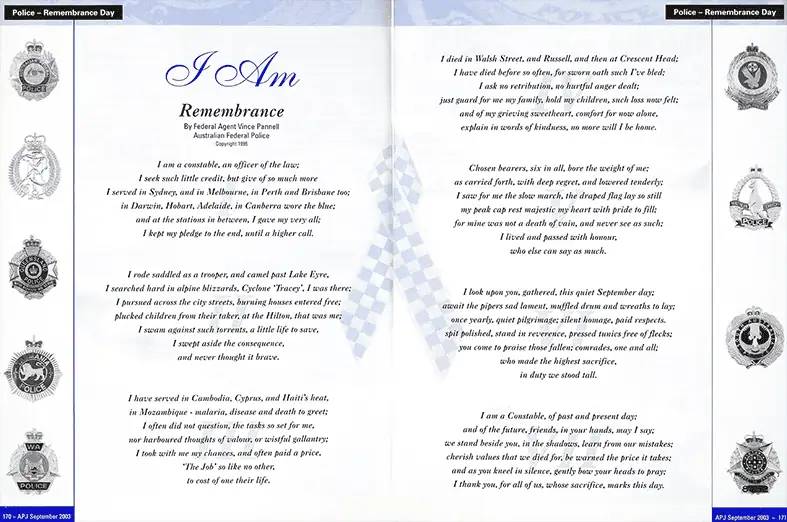
‘I Am: Remembrance’, by Federal Agent Vince Pannell, September 2003.
A beautiful poem about police service and sacrifice, written by a police officer and peacekeeper, for National Police Remembrance Day (NPRD). It’s read aloud at each year’s NPRD service at the National Police Memorial, and can be viewed HERE.
THE SEVENTH DECADE: 2006 – 2015
In 2007 the APJ became an all-colour publication and the company established its first webpage. The following year, long-time editor and stalwart Phil Peters retired from the role. Under Phil’s successor, Geoff Norris, the APJ’s appearance evolved to more of a magazine format, taking advantage of the increasing use of digital photography by police and the general community.
In this era the editorial team aimed to have at least one homicide case study per issue, along with a non-homicide crime case study, a historical/unit history case study, and an educational piece. Articles on concepts and tactics shaped by the ‘global war on terror’, such as active shooter responses, tactical medicine, along with equipment improvements, appeared with more regularity.
Highlighted article
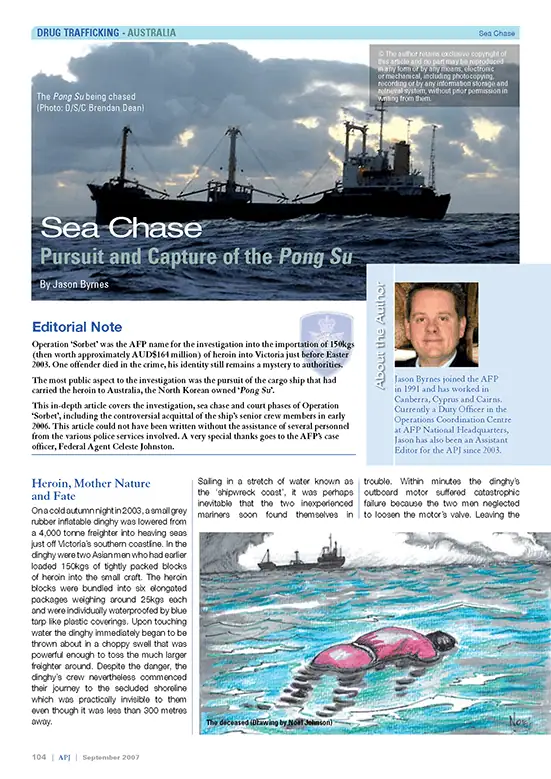
‘Sea Chase: Pursuit and Capture of the Pong Su’, by Jason Byrnes, September 2007.
I hesitate recommending one of my articles but the case itself is an amazing roller-coaster ride starting with a conventional narcotics investigation that quickly escalated with police seizing a large amount of heroin and then finding a dead body hidden on a beach. A maritime pursuit of a North Korean ship then commenced, involving police personnel and vessels from four forces as well as the Royal Australian Navy and Army special forces. The article can be read HERE.
Honourable mention
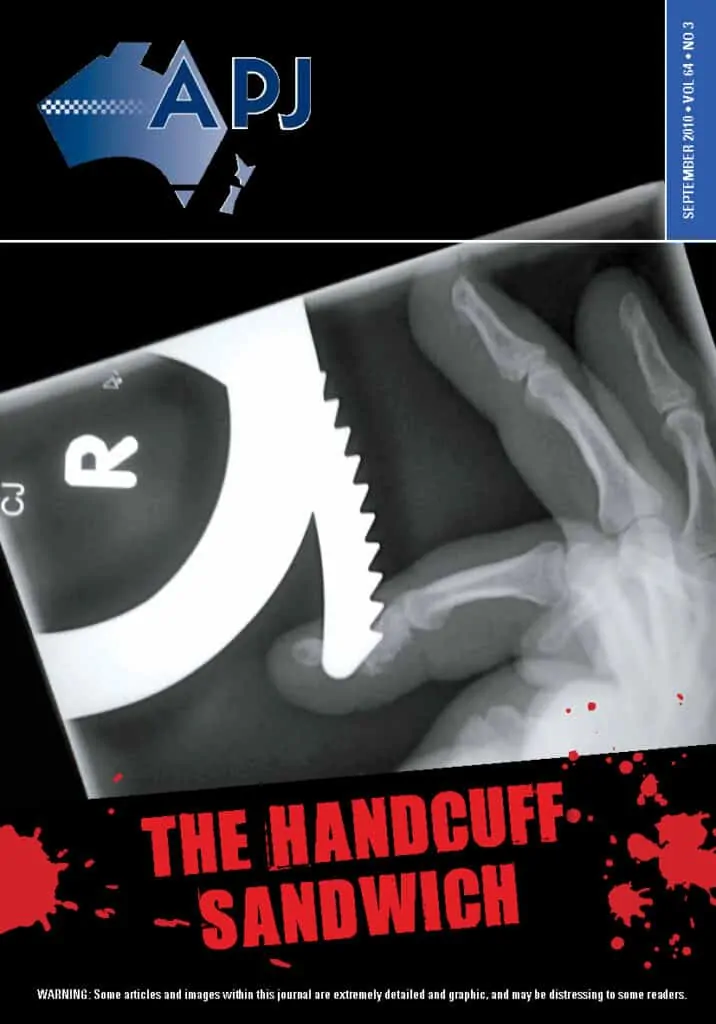
‘The Handcuff Sandwich’, by Sergeant Alan Baker, September 2010.
The author wrote “when you are the centre of attention in a very busy hospital, you’re not having a good night”. This short article is about an arrest that went awry when, mid-scuffle, the offender and author fell to the ground. During the fall an opened handcuff impaled the author’s finger. It’s a tale of bad luck, grit and determination which can be read HERE. It still makes me wince.
THE EIGHTH DECADE: 2016 – 2025
The rapid development of technology and its impact on policing was shown in articles on topics such as body-worn cameras and how police agencies are moving into the digital age. However, reader interest remained very firmly in the case studies of complex and violent crimes, or of policing responses to events such as sieges and natural disasters. The frequency of articles honouring police killed on duty in years past increased as have (sadly) contemporary incidents.
For the APJ itself, technological developments included the introduction of a regular podcast series and a new website where subscribers can access past issues. Technology also enabled the APJ to continue its business unimpeded during the COVID-19 pandemic. Geoff Norris retired as editor in 2018 and was ably succeeded by Pat Paroz and then Simon Bouda in 2022.
Highlighted article
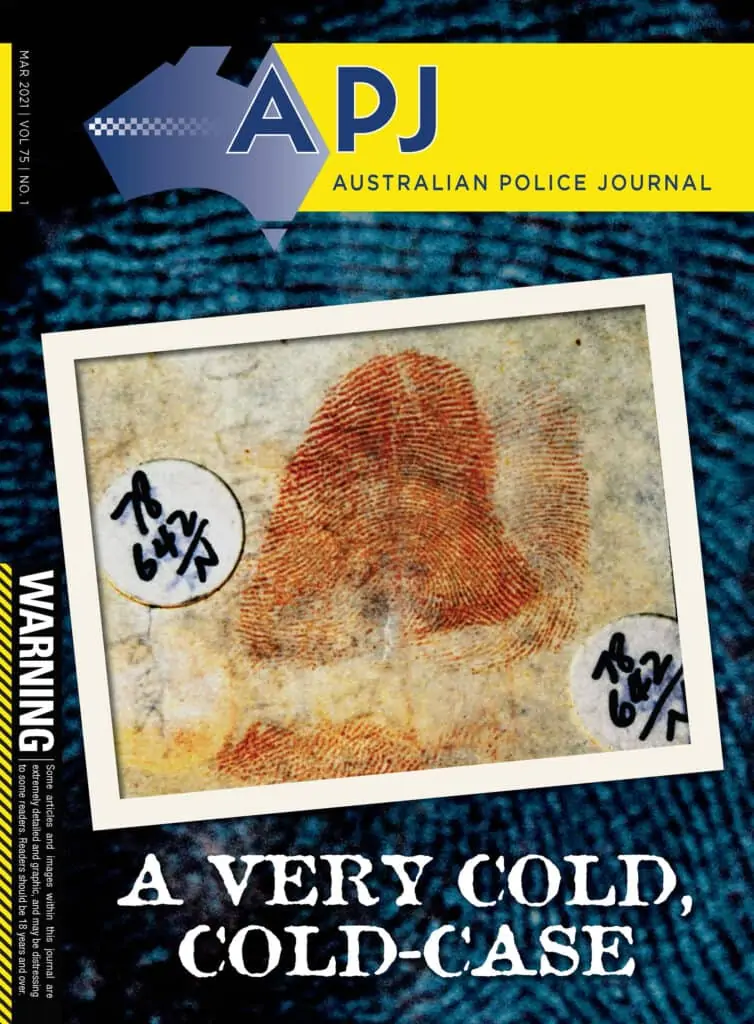
‘Sydney’s Audacious Bank Robber (a Very Cold, Cold-case)’, by Barry Fay, March 2021.
All Barry’s articles are well worth reading but what makes this case stand out is that he played a pivotal role in solving a series of bank robberies despite having been retired for 25 years. Information and advice provided by Barry led police to arrest a man who had committed the offences 40 years previously. The article can be read HERE.
Honourable mention
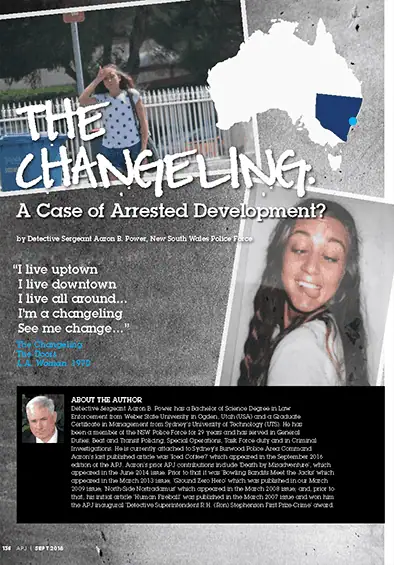
‘The Changeling: A Case of Arrested Development?’, by Detective Sergeant Aaron B. Power, September 2018.
Another great storyteller frequently published in the APJ is Aaron Power. This article is about a police investigation into the actions of a renowned female fraudster who has fooled victims and authorities in multiple countries. The article can be read HERE.
ABOUT THE AUTHOR

Jason Byrnes APM recently retired from the AFP after a 36-year policing career. He has authored numerous articles and two books, and has edited a third book. Jason has been involved in the APJ in various capacities since 2001.

